Copying Every Right Call a Company Makes: Self-evolving Organisations Through Agents
For the past months I have been helping a friend rebuild his company's management system with AI: the number of stores doubled without adding a single back-office hire. This is what we learned about running a company with agents, and the trends we think will follow.
Translated by AI
Originally published on 微信公众号
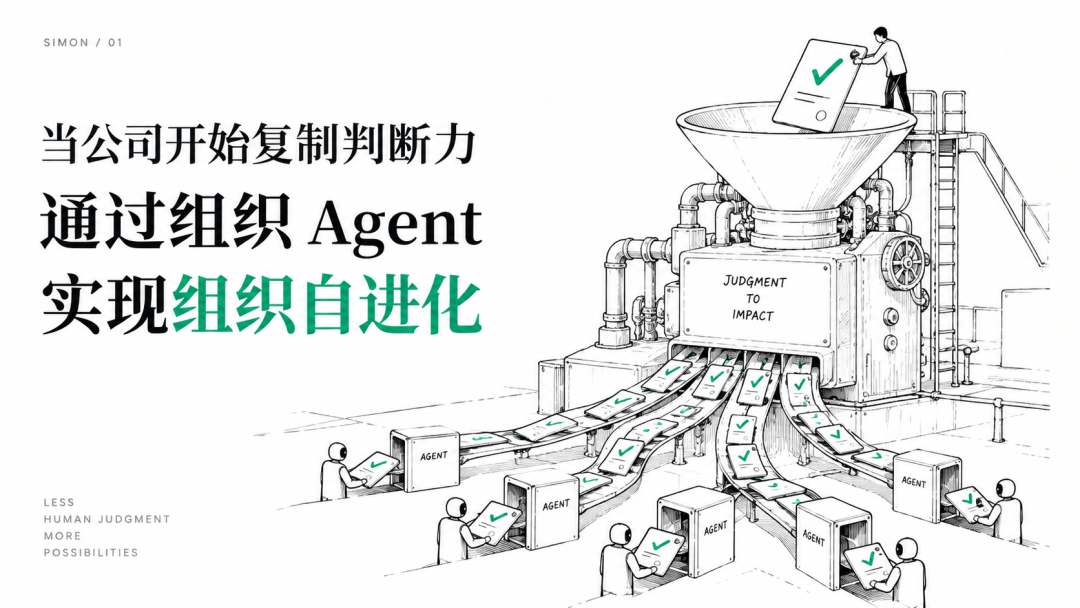
Lately I have been involved in an AI overhaul of the management structure of a friend’s company. He is a co-founder of a designer brand; since he would rather not name the company, I will only talk about what happened.
About half a year ago they began expanding their retail business quickly. By normal retail logic, more stores means bloated middle and back offices: merchandising, operations, supply chain, data, regional management. The hardest part is the truly experienced operators: they are expensive and hard to hire. What makes a good merchandise manager valuable is rarely how many tools they know, but knowing, in a specific situation, whether to follow the rule this time or change it.
Six months later, a set of agents had taken over a large share of the management work. The number of stores, staff, SKUs and the cash flow we manage all doubled, and the back office did not add a single person. The agents read sales, inventory and store data, help design and list new products, track supply-chain progress, generate replenishment suggestions, spot anomalies and escalate what needs a human. Up to this point it still looked like ordinary AI-driven efficiency.
Only in the last month, while helping my friend rebuild his own in-house ERP system according to his own understanding, did we run into a more interesting question: besides goods, services and cash flow, what a company really produces in huge quantities every day is “judgements”.
Who should restock, when to transfer stock, which anomaly is worth handling, what can be decided locally and what must be escalated. The bigger the company, the more of these judgements it makes each day. Much of what we call organisational structure, management systems and back-office roles exists so that these judgements keep happening.
I am increasingly sure of one thing: the Industrial Revolution turned human physical strength into replicable productive capacity; the software revolution did the same for rules; AI is trying to do it for part of the judgement that used to live only in people.
Follow that line and it becomes worth asking again why jobs exist, why management exists, why companies grow bloated as they scale, and what an organisation’s capability is actually made of.
1. If reality were fully certain, we wouldn’t need so many managers
Start with an extreme thought experiment.
Suppose a company’s future were completely predictable: how many units each store sells tomorrow, what each customer buys, when each shipment arrives, what problem each employee will hit — all known in advance. That company would need very little management. Compute the optimal plan and let software execute it.
Management exists largely because reality does not work like that.
Say the ERP automatically transfers stock when an item falls below two units in a store. The rule works well in calm periods. But if there is a promotion in four days, recent sales have suddenly doubled and the warehouse needs five days to deliver, the risk may already be there with six units left.
The system sees a stock number; an experienced merchandise manager sees the future that combination of variables may produce.
Traditional software can, of course, keep adding rules: raise safety stock during promotions, restock earlier when sales accelerate, raise the threshold when lead times grow. As the business gets more complex, weather, influencer exposure, holidays, ad-hoc campaigns, stock-outs in other stores and suddenly trending products keep adding variables. Rules keep multiplying, and reality keeps producing new situations. Commercial reality is always open; a set of pre-written rules always has edges.
So decades of enterprise IT drew a very clear line: certainty was steadily moved into software, uncertainty was steadily left to people.
Order creation, pricing, stock deduction and fixed approvals were gradually automated; what remained looked more and more like judgement. Does this change mean anything? Should we act early? Is this a special case? A company therefore runs on two systems. One is the ERP, CRM, OA and formal processes; the other is phone calls, group chats, ad-hoc meetings, experience, and the sentence every company knows: “This case is a bit special.”
That is also why middle and back offices thicken as a company grows. More business brings more data and more exceptions. Processes handle the normal cases; managers absorb what processes cannot.
Seen another way, management costs have always hidden a large expense: an uncertainty tax. The more complex reality gets, the more a company has to pay that tax in human judgement.
2. Job boundaries may shift as judgements are split apart
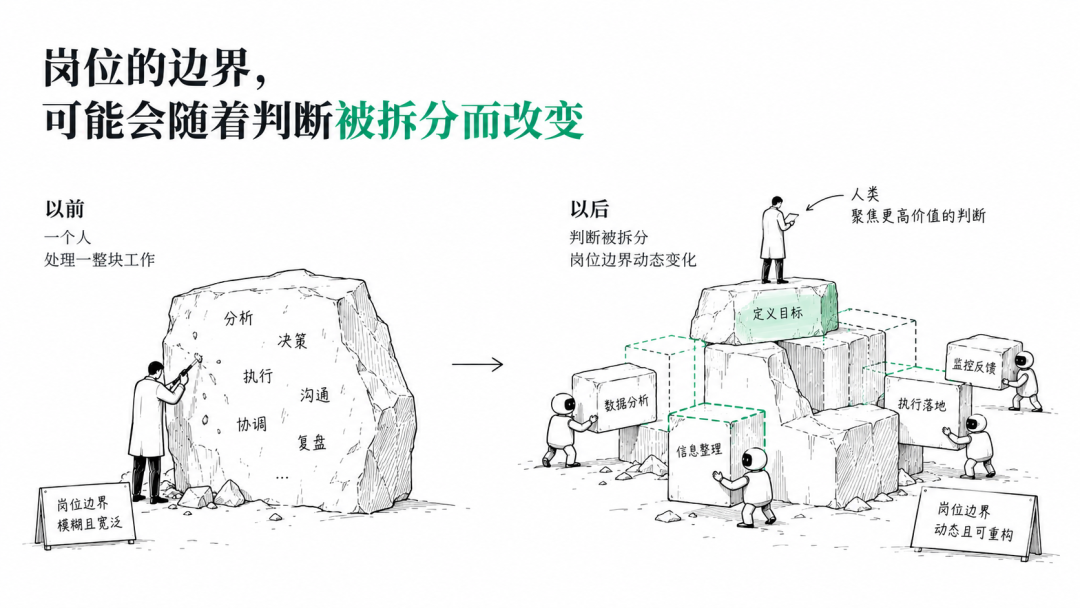
The Industrial Revolution did something important: it gradually separated capability from the judgement of a particular person.
Moving a hundred tonnes once took many people; with machines, one person could command force far beyond their body. Software achieved another separation. Executing a complex set of rules once required many people repeating the same operations; once rules became code, a program could run a million times at almost no extra cost per run.
AI is attempting a third separation: judgement is beginning to separate from the individual.
At first we also designed agents around real job titles. There is a merchandise manager, so we built an AI merchandise manager; an operations role, so an AI operator; supply chain, so an AI supply chain. We gave each one the data, rules and documents of the job and hoped it would take over the whole thing.
After running it for a while, problems appeared. A merchandise manager has to watch inventory, sales, promotions, store differences, lead times and product life cycles. The more information an agent carries and the more mixed its goals, the vaguer its answers become.
“Overall sales are stable; focus on stock of best-sellers, strengthen store transfers, and keep monitoring abnormal trends.”
Every sentence is reasonable, and almost nothing is actionable. Worse, when the outcome is wrong it is hard to tell at which step it went wrong: the inventory call, the trend detection, the promotion weighting, missing information — any of them.
So we started splitting things differently. The question changed from “which job can AI take over?” to “what judgements does this job actually make every day?”
Split that way, the structure became much clearer. In a complete merchandising role, perhaps only a dozen or so nodes truly need fuzzy judgement: is this sales change abnormal, is there a future stock-out risk, should these two stores transfer stock, is this outside the normal range of operations?
Most of the rest stays with traditional software. What can be computed is computed; what can be written as clear rules stays as rules. Models only enter where rules cannot be exhaustive and the problem is still well bounded.
Go further and the job itself starts to look less solid, because one key constraint in designing jobs has always been that people can’t be split.
A merchandise manager handles twenty kinds of work today largely because a company buys a whole person: eight hours a day, one title, one salary. Many related tasks have to be bundled together.
A job is therefore both a division of labour and a way of packaging expensive human cognition. That constraint is starting to loosen.
Models are called in a completely different way. A model can run for 300 milliseconds and answer just one question: “Does the current sales curve show an anomaly worth acting on?” When it answers, that unit of cognition is released. Next time a judgement is needed, it is called again.
This means for the first time a company can buy part of its cognitive capacity “per decision” instead of “per person”. The change is easy to underestimate.
So in building the system we gradually dropped ideas like “an AI merchandise manager”. Once an agent takes on a whole job, what it needs to know balloons, the context gets long, the goals multiply and the answers become vague. It works better to split the judgements directly: Is there a sales anomaly? Is there a future stock-out risk? Should these two stores transfer stock now? Has this event gone beyond normal operations? Each question is narrow, and the model gets only the information needed for that one judgement. (At the finest level, for instance, we only use DeepSeek V4 Flash, often without even turning on reasoning.)
Carried further, this produces a change worth watching:
Companies used to organise cognition by “job”; in future they may increasingly organise it by “decision”.
3. Hierarchy exists to compress the complexity of a company’s decisions
One layer down is a more basic question: why do companies need hierarchy?
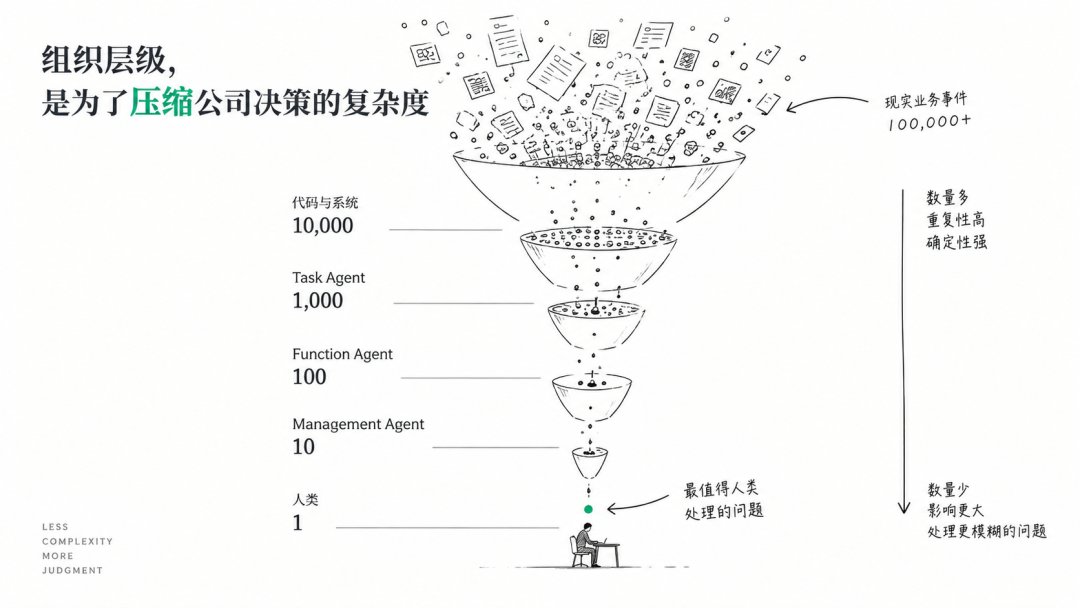
A large company produces enormous amounts of information every day. If everyone saw everything and took part in every judgement, the organisation would quickly seize up. A company has to keep cutting reality into smaller problems and handing different problems to different people. A role specifies not only what a person must do, but also on which information, goals and premises they should judge. A job defines at the same time “what you should care about” and “what does not need to enter your field of view for now”.
A shop assistant can handle routine returns; special complaints go to the store manager. The store manager handles most store problems; brand policy or large sums go to the regional manager. The higher up, the fewer problems, but each one is fuzzier, broader in impact and potentially more costly. In a well-run company, every layer keeps “eating” the uncertainty produced by the layer below.
From this angle a company resembles a complexity compressor. A hundred thousand things may happen in a company in a day; the top manager should really see only a tiny fraction. The front line solves ordinary problems, middle management digests exceptions the front line cannot, and higher levels handle what still remains unsolved.
This is also the precondition for growth. The top manager’s cognitive capacity does not grow with the company; the organisation compresses most problems in advance through division of labour, authority and hierarchy. So a core function of hierarchy is to let the highest cognitive capacity deal only with the problems most worth its attention.
This also explains why the vision of “one boss plus ten thousand agents” may be too simple.
If ten thousand agents are each unsure about one thing a day, the boss soon receives ten thousand messages. He has ten thousand digital employees — and ten thousand new people reporting to him.
So a truly scalable AI organisation will most likely still be layered. At the bottom, deterministic code for well-defined problems; above it, small models with only local information handling frequent, low-risk, limited judgements; above them, models with more context and authority absorbing the exceptions from below; and finally the small remainder that cannot be handled goes to people.
The core of this structure is no longer “who reports to whom”. It solves a resource-allocation problem: what level of intelligence should be spent on what level of uncertainty. Hierarchy may well persist; only what it is made of changes. Code, models of different capability and people will coexist in a new decision network.
4. The stronger the model, the clearer its authority must be
By this point I increasingly felt that many companies focus on the wrong thing when they talk about agents. Everyone cares how smart the model is, how many parameters it has, how well it reasons. But inside a company, “smart” has never been the only variable.
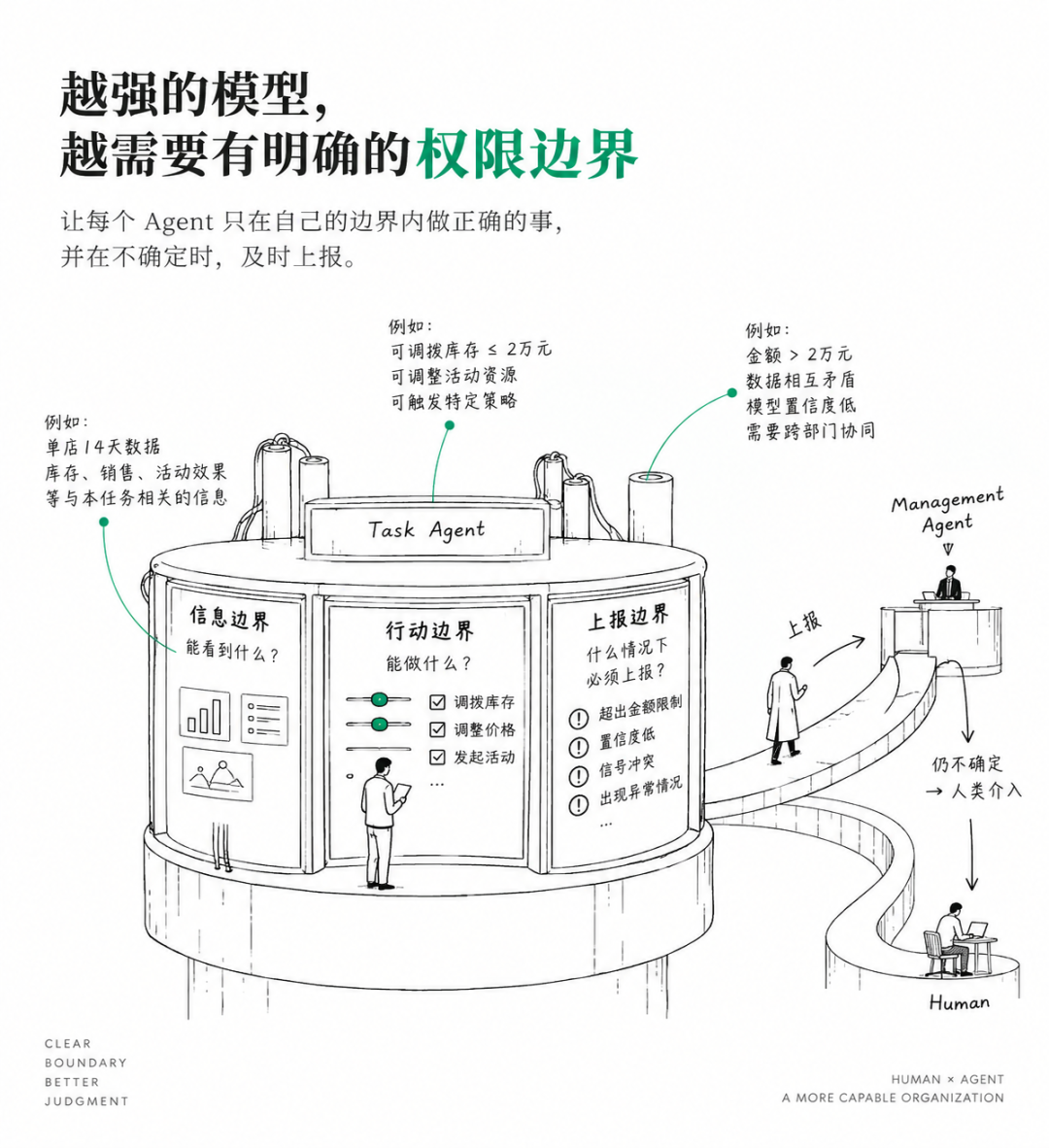
A very smart new hire who on day one has access to all the company’s bank accounts is still a disaster. Agents are the same. Once in the business, every agent faces at least three questions: What can it see? What can it decide? When it gets it wrong, who bears the consequences? These correspond to information, power and responsibility.
Human organisations have long worked this out. A new employee can start work without knowing everything about the company, because the organisation has drawn the boundaries in advance: what sums you can handle yourself, when to ask your supervisor, when to escalate further. Organisations do not require every front-line member to have top-level judgement. They rely on local competence and clear boundaries.
Agents inside a company will gradually form similar structures. A small model handles one kind of problem with information and authority to match. If it can’t, it escalates; the next level has more information and wider discretion; if that still fails, a person takes over. In agent governance these settings can become far more precise than “has access” or “doesn’t”: we can decide that an agent may only look at one store, only the past fourteen days, only call three tools, only approve transfers under 20,000 yuan, and must stop when certain signals contradict each other.
The stronger AI gets, the more this matters. A weak model can at worst give a stupid suggestion. A strong model with information, tools and authority at once can turn a wrong suggestion into reality immediately. So the hard part of an agent organisation may in the end not be prompt engineering, but:
Decision rights engineering.
5. Once judgement enters software, companies accumulate a new kind of data
I later proposed an improvement: every decision should be annotatable, and should show the information that was relevant at the time. Pushed further, this touches an important issue for AI in companies. A company cannot just know what the system finally did; it needs to be able to reconstruct the decision context.
For a replenishment decision, you should be able to see the stock level at the time, how sales were moving, what information the agent had, how much authority it had, whether escalation was triggered and who finally confirmed the action. If things go badly, you can retrace the chain. What needs to be kept are the facts, grounds, authority, path and outcome of the decision.
Companies have accumulated vast amounts of sales, inventory, customer and financial data, yet rarely recorded “why we decided this at the time”. Much operating experience lives in people’s heads, scattered across group chats, meetings and ad-hoc conversations. As AI takes part in more business nodes, each judgement naturally leaves a structured record. A company thus gradually acquires a kind of data it never had in full:
Decision data.
With this layer, a company no longer sees only business outcomes. It begins to observe its own judging. Suppose an inventory agent handles ten thousand tasks a month, completes 9,500 itself and escalates 500. The next level resolves 450, and the last 50 reach a person. For efficiency, the 9,500 automatic completions matter a lot. For long-term learning, the 500 escalations may be more worth studying.
If one kind of problem keeps being escalated, the reasons may be very concrete: the agent is missing a data field, its authority is too narrow, a business rule has changed, or the decision node was badly drawn in the first place. If something that happened once in six months now happens dozens of times, the “anomaly” may be becoming the new normal. Once decisions are recorded continuously, problems that people handled can feed the next round of system changes. A person steps in once today; tomorrow the system adds a piece of information, adjusts an authority or redraws a node, and similar problems can then be resolved lower down.
Traditional companies also learn from experience, but loosely. A good employee handles a special case, explains it in a chat, and that’s it. Months later someone else meets a similar problem and probably has to judge it from scratch. When people leave, some of the experience leaves with them. The truly important reasoning evaporates when the meeting ends. This may be a huge hidden loss in traditional organisations: a company produces experience every day and loses experience every day. Once exceptions and corrections are structured continuously, a company for the first time has a chance to keep them. Each new exception exposes a gap in the current system’s knowledge and becomes material for the next improvement.
6. Preserved judgement becomes a new management lever
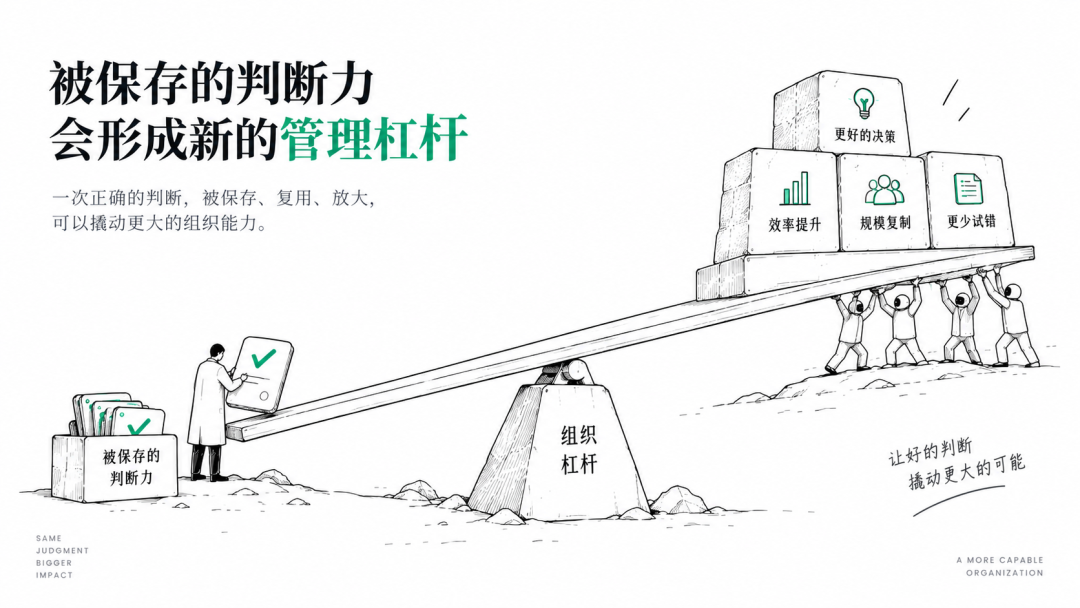
Looking again at growth, an important change appears.
When a traditional company scales, it has to replicate a lot of human judgement. A good regional manager can run ten stores; at fifty stores you need to train or hire more people like them. Merchandising, supply chain and operations have the same problem.
Machines can be bought, stores leased, capital raised, but mature operating experience is hard to copy quickly. For many companies, at a certain stage, what really limits growth is the organisation’s ability to develop people.
If part of the local judgement a manager builds up over years can gradually settle into data, rules, models, permissions and exception paths, that experience starts to become cheaper to copy.
An inventory approach validated in one store can be deployed directly to the second; the second store meets new situations and provides new samples. As stores are added, part of the operating experience spreads with the system, without every team having to learn it again.
Human creativity, relationships, value judgements and accountability still depend heavily on individuals. The part of operating judgement that recurs, has relatively clear inputs and outputs, and produces verifiable results will become easier to externalise.
So a new layer appears among a company’s assets:
Operating judgement preserved by the system.
For centuries technology has lowered the cost of copying some capability. Machines extended physical strength, capital extended the ability to mobilise resources, and software let a program be used countless times at almost no added cost. AI is giving part of judgement similar properties.
What a good merchandise manager can carefully handle in a day is always limited. If some of their ways of judging can enter the system, then once an experience is formed it may act on ten or a hundred stores at once. The company’s growth function changes too. As the business grows, the number of people making everyday judgements need not grow at the old rate; new costs will include more compute, model calls, data infrastructure, and a few people who handle new exceptions.
Managers’ work may therefore move upstream: setting goals, drawing boundaries of authority, resolving conflicts of value, deciding which errors are acceptable and which problems must come back to people. A good manager used to rely on making many good decisions personally. In future they will also need to design a structure in which many repeated decisions happen reliably, while the truly critical ones are routed precisely to them.
7. A new unit of cost: scarce human judgement per unit of business
If such a system holds, some management concepts that used to be very abstract suddenly become measurable — for example, “organisational learning”.
We used to say a company learns fast as a qualitative judgement. In future you could look directly: out of ten thousand business events, how many needed human judgement? How many of those were problems that had happened before? From the first appearance of an anomaly to the system handling it reliably, how many human interventions did it take? How often is a given node overruled by the level above?
These numbers describe how fast a company digests the unknown. I think one could even define a very simple metric: how much “scarce human judgement” a unit of business requires.
Suppose two companies each handle a million business events a month. Company A needs senior managers to step in 20,000 times; company B only 2,000 times. Both use exactly the same foundation model. The real gap has already opened inside the organisation: B’s system has pushed more known problems down to lower levels, so its scarcest human attention can keep working on genuinely new problems.
Management capability gains a new measure: a good organisation keeps turning “problems that used to need an expert” into problems that no longer do. Perhaps an expert’s best work is gradually eliminating their own past work.
8. A judgement flywheel is starting to turn
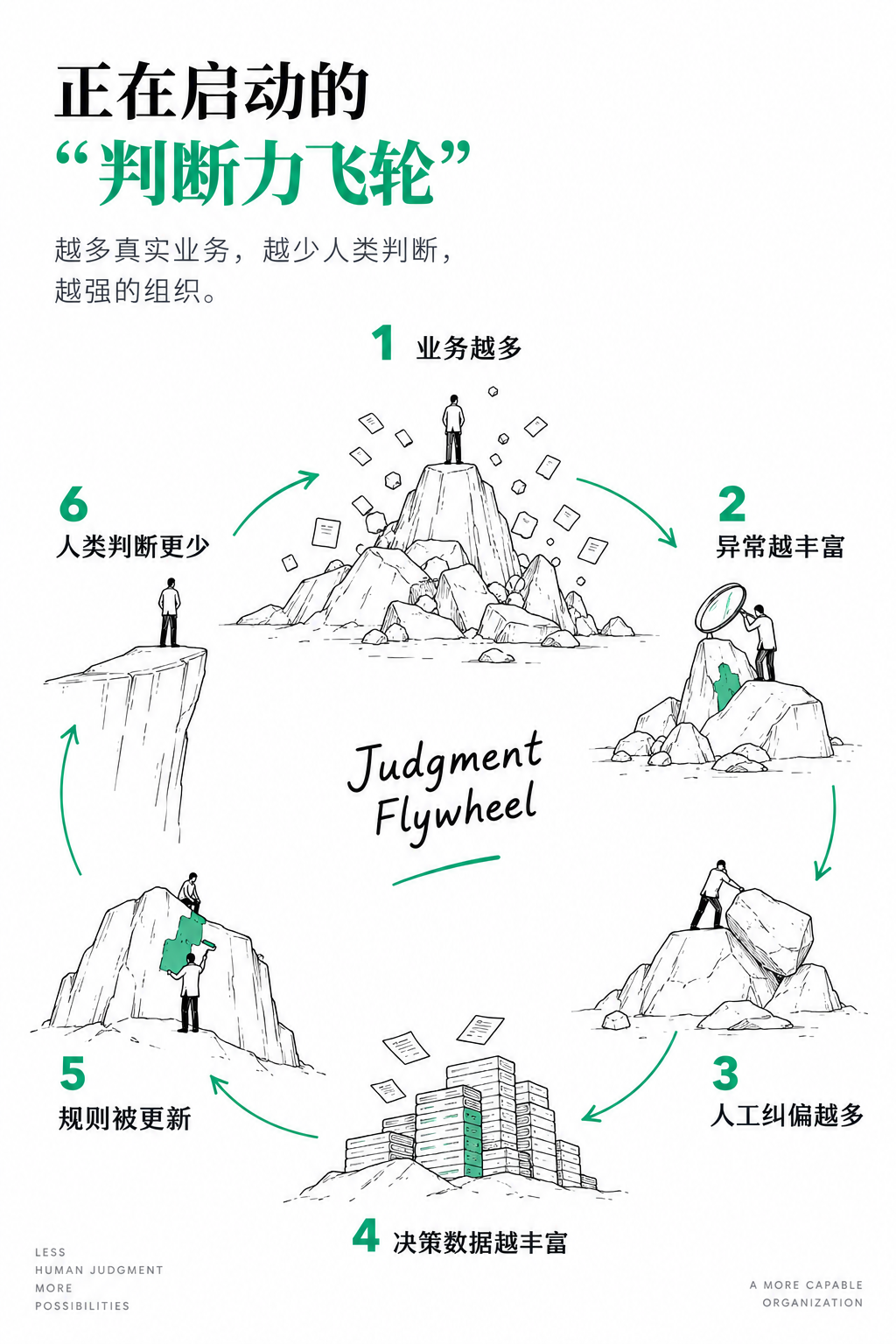
When traditional companies expand, much of the business can even be scaled quickly with funding. What is slow is often the organisation. A good regional manager can lead ten stores; at fifty you need to develop four more. Heads of merchandising, supply chain and operations face the same problem. Their judgement cannot be copied quickly, so many companies’ growth curves end up capped by organisational capability. The front end can keep growing while the back end starts to lose control.
If AI can capture part of this local judgement, it changes the cost of copying. Problems the first store went through need not all be relived by the second. New anomalies found by the tenth store become system updates for the first nine. For the first time, scale may in turn improve the system’s judgement.
This matters. Scale used to mean more complexity. In some AI-native systems, scale will also mean more decision samples, more anomaly samples and more correction records. If the learning mechanism works, scale itself becomes a learning advantage.
So a new flywheel may appear:
More business → richer anomalies → faster system learning → less human judgement per unit of business → capacity for more business.
That, I think, is the economy of scale agents may really bring.
9. The real moat shifts from “the model” to “the history of corrections”
If the strongest foundation models are available to everyone, the model itself can hardly be a lasting moat. A competitor can buy the same model tomorrow, but it cannot buy your past.
It does not know which anomalies your company met in the last three years, which judgements led to disaster, which seemingly abnormal signals came to nothing, what must be left to people, and where you can automate boldly. These things settle into decision data, evaluation systems, authority boundaries and the history of corrections. So two companies using exactly the same model may still show entirely different “personalities”.
One system is cautious and escalates anything slightly complex. The other has seen a hundred thousand similar cases in some line of business and can act automatically and boldly.
What forms the barrier then is: the model × the company’s experience.
As base intelligence becomes a commodity, distinctiveness will come more from long-term feedback. In other words, a company’s real AI asset may not be “we use the latest large model”, but: how many high-quality corrections we have preserved.
10. Where people stand
Down this path, the place of human managers changes too. As everyday judgement sinks lower, people concentrate in a few places: defining goals, drawing authority, handling new exceptions, resolving conflicts of value and bearing final responsibility.
There is an important dividing line.
Models are getting ever better at answering: how do we achieve a goal?
People increasingly have to answer: which goal is worth achieving?
An inventory system can optimise turnover, a marketing system conversion, a sales system revenue. But whether a brand should sacrifice its aesthetics for conversion, customer experience for turnover, or long-term brand value for quarterly revenue cannot simply be computed from historical data, because it is a question of ranking values. The more automated a company becomes, the more its objective function matters.
Give a vague goal to a hundred people and errors spread slowly, damped by human hesitation and friction. Give a wrong goal to a highly automated system and it may be executed perfectly. So the stronger AI gets, the fewer — and the more precious — the things humans at the top truly have to get right. Once the direction is wrong, efficiency is an accelerant.
Finally
We started all this only because the company was growing and people were expensive and hard to hire. Then agents took over part of the back-office work and the business kept moving. Then we began taking the ERP apart, handing nodes that fixed rules could not reliably cover to small models, escalating what models could not solve, and keeping every human correction.
By now I increasingly feel that what we are doing is no longer just automation. It touches an underlying mechanism of the company: how an organisation turns the uncertainty of reality into judgements it can act on.
That capability used to live mainly in people, jobs and hierarchy; part of it is now moving into agents plus software. If this keeps developing over the next few years, there may be a very simple test of whether a company has truly been transformed by AI: today an expert personally handled a new problem; the second time the same problem comes up, does the company still need that same expert?
If it always does, the experience still belongs to the individual. If the second time it can be pushed down, the third time handled automatically, and by the tenth time it has become a deterministic routine, then the experience has started to belong to the organisation.
Perhaps this is what is truly fascinating about AI. We once used machines to copy strength and software to copy rules. Now, for the first time, we are starting to try to:
copy judgement.